|
|
“Today amid so much darkness we need to see the light of hope and to be men and women who can bring hope to others. To protect creation, to protect every man and every woman to look upon them with tenderness and love, is to open a horizon of hope. It is to let a shaft of light break through the heavy clouds.” Pope Francis |
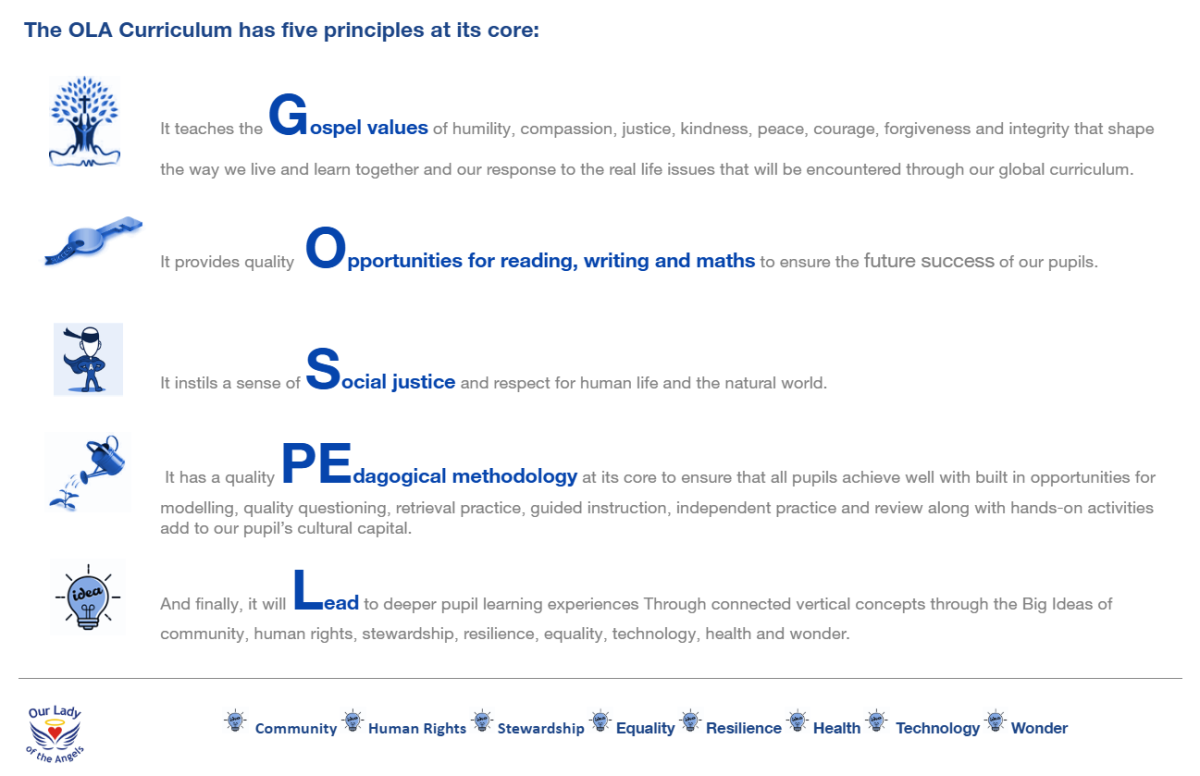
Our curriculum is intentionally shaped around eight “big ideas” that help children understand themselves, others, and the world. These ideas act as golden threads, weaving through subjects, experiences, and school life so that learning feels meaningful, connected, and rooted in strong values.
Community
How it links:
Children learn that they belong to many communities—class, school, family, local area, faith groups, and the wider world. Subjects such as RE, PSHE, history, and geography help them explore how communities work, how people support one another, and how shared responsibility builds a sense of belonging.
Why it matters:
Understanding community nurtures empathy, cooperation, and active citizenship. It helps children see that they have a role to play in making their world kinder and stronger.
Human Rights
How it links:
Through PSHE, RE, history, and assemblies, children learn about fairness, dignity, safety, and the rights all people share. They explore how rights protect individuals and how responsibilities help uphold those rights for others.
Why it matters:
Human rights education builds moral awareness and encourages children to stand up for justice, respect difference, and recognise the value of every person.
Stewardship
How it links:
Science, geography, RE, and outdoor learning teach children how to care for the environment, resources, and one another. They learn about sustainability, responsibility, and the impact of their choices.
Why it matters:
Stewardship develops character. It helps children grow into thoughtful, responsible people who understand that their actions shape the future of their community and planet.
Equality
How it links:
Across the curriculum, children encounter diverse stories, cultures, histories, and perspectives. PSHE and RE explicitly teach respect, inclusion, and fairness. Literature, art, and history help children see how inequality has been challenged and overcome.
Why it matters:
Equality ensures every child feels seen and valued. It teaches pupils to challenge discrimination and to celebrate the richness of difference.
Resilience
How it links:
In every subject, children are encouraged to persevere, problem‑solve, and learn from mistakes. PE, science investigations, writing processes, and maths reasoning all provide structured opportunities to practise resilience.
Why it matters:
Resilience equips children to cope with challenge, adapt to change, and develop confidence in their ability to grow.
Health
How it links:
Health education is woven through science, PE, PSHE, and daily routines. Children learn about physical health, mental wellbeing, nutrition, exercise, sleep, and personal safety.
Why it matters:
Healthy children learn better, feel better, and are better prepared for life. Understanding health empowers them to make positive choices.
Technology
How it links:
Computing, science, design technology, and online safety lessons help children understand how technology works, how it shapes society, and how to use it safely and creatively.
Why it matters:
Technology is central to modern life. Children need digital literacy, critical thinking, and safe online habits to thrive in a rapidly changing world.
Wonder
How it links:
Wonder is nurtured through RE, science, art, music, literature, and outdoor learning. Children are encouraged to ask big questions, notice beauty, explore mysteries, and stay curious.
Why it matters:
Wonder fuels imagination, spiritual development, and a lifelong love of learning. It helps children see the world as a place full of possibility.
These big ideas are not separate topics—they are the foundations of a curriculum that shapes the whole child. They guide what we teach, how we teach, and the kind of people we hope our pupils will become: curious, compassionate, resilient, responsible, and ready to contribute to the world with courage and kindness.